
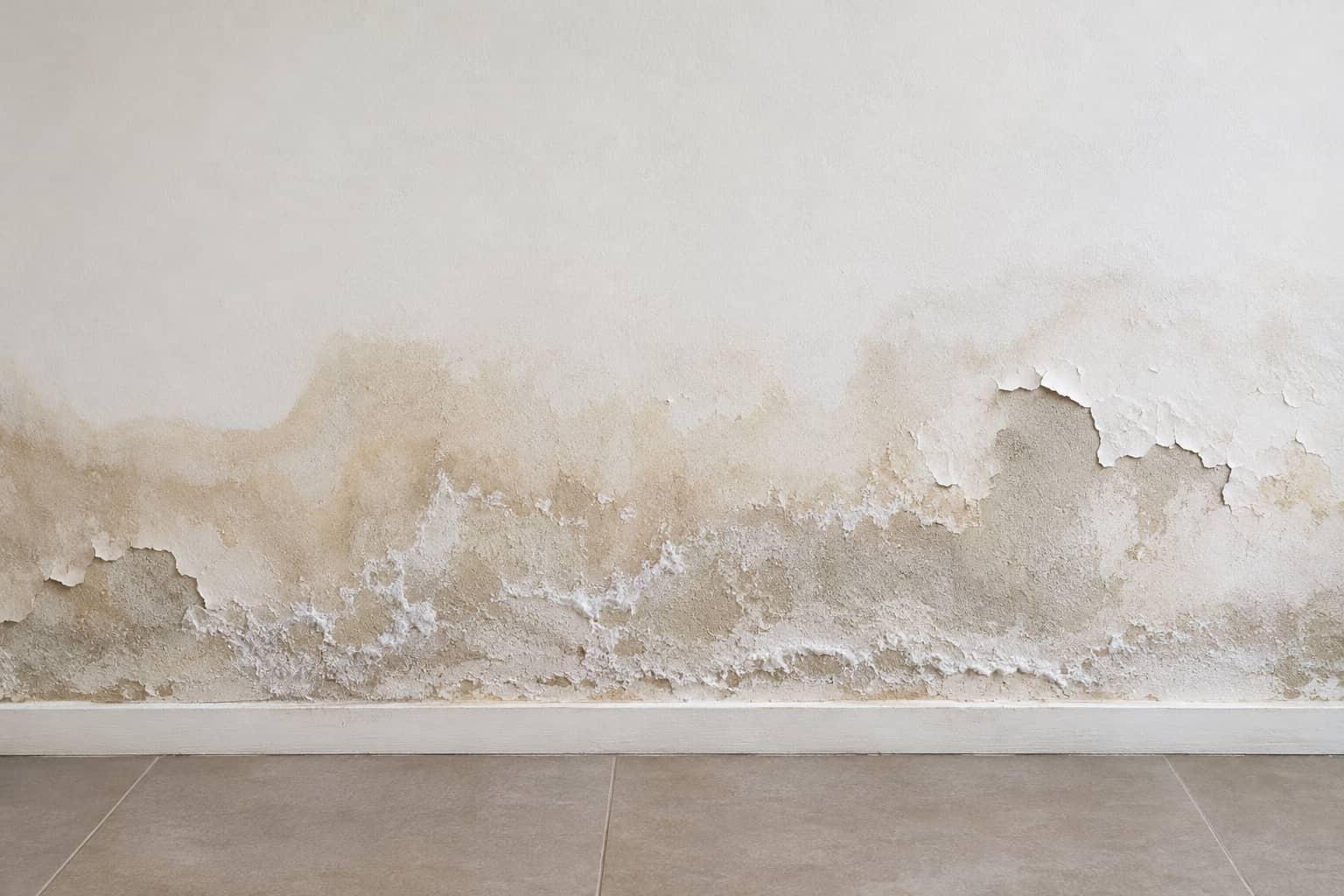
A dark stain rising from the skirting board, blistering paint, a fine white powder on the wall… rising damp is one of the most common defects in older homes and buildings, and also one of the most poorly treated: it gets painted over, tiled or covered with a skirting, and a few months later it comes back.
In this article, drawing on our experience as renovation architects, we explain exactly what it is, how to tell it apart from other types of damp and which solutions really work.
What is rising damp?
It is groundwater that rises up the walls through the pores of the materials, just as a liquid climbs a wick or a paper napkin. Brick, stone, mortar and concrete are porous materials: if they are in contact with damp ground and nothing stops it, they absorb water and draw it upwards.
Why water rises up walls
The pores in the materials act like tiny tubes. The surface tension of water makes it rise through them until evaporation at the wall surface balances what comes in from below. That is why the stain usually stays at a fairly stable height, normally below one metre, although it can go higher if the wall is covered with materials that do not let it breathe.
Which buildings are most affected
- Older homes built without a damp-proof course between the foundations and the walls, which was common before the 1970s.
- Ground floors and basements in direct contact with the ground.
- Load-bearing walls of stone or solid brick, which are very porous.
- Buildings in areas with a high water table, such as those near the coast or watercourses.
- Houses where the pavement or outside ground level has risen over the years and covered the original damp-proof course.
It is a defect we often find when inspecting older buildings, along with others such as aluminosis or cracks caused by ground settlement.
How to recognise rising damp
Most common symptoms
- Dark stains on the lower part of the walls, with an irregular or wavy upper edge.
- Salt deposits: white, powdery efflorescence, which is the salts carried by the water crystallising as it evaporates.
- Blistered or flaking paint and plaster that crumbles to the touch.
- Skirting boards that come loose or rot.
- A musty smell and, in some cases, mould on the lower part of the walls.
- It gets worse after rainy spells and improves somewhat in summer, but never disappears completely.
Rising damp, condensation or leaks: how to tell them apart
Before choosing a solution you need to know what type of damp it is. Treating condensation as if it were rising damp, or vice versa, is money wasted.
| Type of damp | Where it appears | When it gets worse | Typical sign |
|---|---|---|---|
| Rising damp | Lower part of the walls, from the floor up | After rain and in winter | Salt deposits and a wavy line below 1 m |
| Condensation | Corners, ceilings, behind furniture, windows | In winter, when cooking or showering | Black mould on cold spots |
| Leak | Near roofs, terraces, façades or pipes | Right after rain or after using water | A localised stain that spreads from one point |
How it is diagnosed
Visual inspection
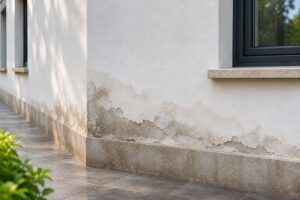
A specialist checks where the stain is, how high it reaches, whether there are salt deposits, what the wall is like and what is on the other side: ground, a pavement, a courtyard or a neighbouring home. They also check whether the outside ground level is higher than the inside floor.
Moisture measurements
A moisture meter is used to measure the moisture content of the wall at different heights. If moisture is highest at the bottom and decreases further up, it is a clear sign of rising damp. In doubtful cases, samples can be taken from the wall to measure water and salts in a laboratory.
Ruling out other causes
A leak in a concealed pipe or in the drainage can cause very similar symptoms. Before taking action, it is worth checking the plumbing, especially if the stain is recent or very localised.
Solutions to get rid of rising damp
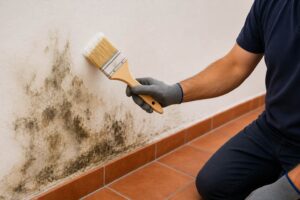
The right solution depends on the type of wall, its thickness, whether work can be done from outside and the budget. In most cases two things are combined: stopping the water rising and restoring the wall so that it can dry out.
Chemical injection damp-proof course
This is the most widely used solution. Holes are drilled at the base of the wall, a few centimetres above the floor, and a water-repellent product (usually silicone- or silane-based) is injected to block the pores and create a horizontal barrier. It works well in brick and stone walls if carried out with the right spacing and amount of product.
Electro-osmosis
This involves fitting electrodes in the wall that reverse the movement of the water. It is less invasive, but its effectiveness depends heavily on the type of wall and the salts it contains, so it is best assessed with a specialist before installation.
Perimeter drainage and external waterproofing
When it is possible to dig outside, in detached houses for example, the longest-lasting solution is to keep water away from the wall: perimeter drainage, a waterproof membrane on the outer face and, if necessary, lowering the ground level. It is more expensive, but it tackles the cause.
Restoration renders
Once the damp has been stopped, the plaster and mortar damaged by the salts must be removed and replaced with breathable restoration mortars, which let water vapour out and hold the salts inside without them showing on the surface. If the wall is re-plastered with ordinary gypsum or cement, the salt deposits come back.
What doesn’t work
- “Anti-damp” paint: it hides the stain for a few months, but the water keeps rising and ends up finding a way out higher up.
- Tiling or fitting skirtings: they cover the wall and push the damp further up.
- Unventilated linings: a plasterboard partition against a damp wall leads to mould behind it.
- Waterproof cement renders: they stop the wall breathing and make the problem worse.
If, after treating the damp, you want to make your home more comfortable, you may be interested in our guide to the best thermal insulation for walls, always choosing materials that let the wall breathe.
What if the damp is in a block of flats?
In blocks of flats, the walls, façade and foundations are, as a general rule, common elements. That is why, when rising damp comes from the building’s structure, the repair is usually the responsibility of the owners’ association rather than the ground-floor neighbour.
In addition, damp on the ground floor and in basements is one of the points the inspector checks in the Building Technical Inspection (ITE). If your building is more than 50 years old, you should know how often the ITE must be carried out and what happens if it has not been done. If you need one, see our ITE service in Málaga.
When to call an architect
It is worth having a specialist look at it if the damp affects several rooms or common areas, if it has come back after treatment, if there are cracks as well as stains or if you are going to renovate. A renovation is the ideal time to fix it properly, before new finishes go on: we take this into account in all our full renovations in Málaga.
If, as well as the damp wall, you notice cracks in the floor or walls, there may be a ground problem: we explain it in how to repair foundation subsidence. And remember that a home with serious damp may not meet the habitability requirements for a home.
💧 Do you have damp at home or in your building?
We diagnose the cause, tell you which solution you need and take care of the work. Find out about our building rehabilitation in Málaga service or talk to our architects in Málaga.
Frequently asked questions about rising damp
It does not usually compromise the structure in the short term, but over the years it degrades mortars, plasters and bricks, encourages mould and worsens indoor air quality. The sooner it is treated, the simpler and cheaper the repair.
Yes, if the rising water is stopped with a properly installed barrier or kept away from the wall with drainage and waterproofing, and the finish is then restored with breathable mortars.
It depends on the thickness of the wall and the climate, but it normally takes several months. Until the wall is dry, it is best not to apply final finishes or paint.
It does not solve the problem. It hides the stain for a while, but the water keeps rising up the wall and ends up appearing higher up or making the paint flake.
It is the mineral salts carried up from the ground by the water. When the water evaporates at the wall surface, the salts crystallise and form that white powder. It is one of the clearest symptoms of rising damp.
If the damp comes from the walls or foundations, which are generally common elements, the repair is usually the responsibility of the owners’ association. It is advisable to have a specialist determine the cause and to check the association’s bylaws.
