
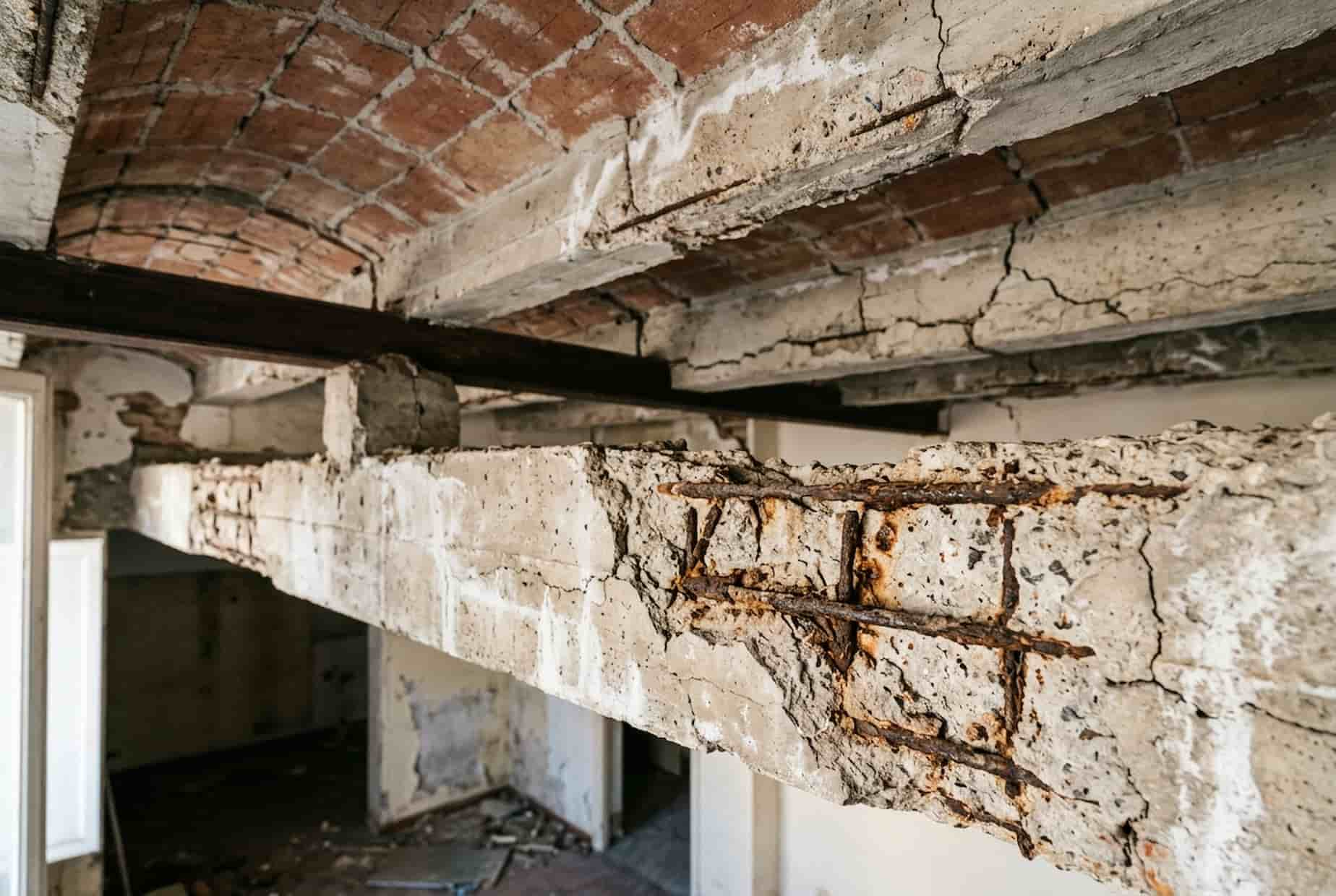
When someone is thinking of buying a flat built between the 1950s and the 1980s, the word “aluminosis” tends to come up sooner or later. It sounds technical, almost like something from a laboratory. But behind the term lies a very real structural defect that in Spain has forced entire buildings to be propped up, homes to be evacuated and even whole blocks to be demolished.
In this article, drawing on the experience of an architecture studio specialising in refurbishment, we explain what aluminosis is, how to recognise its symptoms, how it is diagnosed technically, what solutions exist and what legal and financial implications it has if your building is affected.
What aluminosis is and why it is a serious problem
Aluminosis is a structural defect of reinforced concrete caused by the use of high-alumina cement (CAC-R) in the manufacture of joists and floor slabs. It is also known as “concrete fever”, by analogy with a disease that progressively degrades the material.
This cement, made from bauxite and limestone with a high concentration of alumina, was used in Spain between 1950 and 1980, peaking between 1960 and 1975. Its great advantage was its rapid setting, which sped up construction times. The problem appeared over time: in conditions of high humidity and high temperatures, its crystalline structure undergoes a chemical transformation called “conversion” (from hexagonal to cubic) that increases the porosity of the concrete. And greater porosity brings two serious consequences:
- Loss of mechanical strength. The concrete can no longer bear the loads it was designed for.
- Vulnerability to external agents. Water and chlorides reach the internal reinforcement, which rusts, expands and “bursts” the concrete from the inside.
The most famous case in Spain was the Vicente Calderón Stadium in Madrid, where its proximity to the Manzanares river and the M-30 motorway accelerated the process. But there are thousands of residential buildings, especially in Barcelona, Madrid, Seville and industrial cities, with this latent problem. The process is irreversible: once it has started, it can only be offset with reinforcement or replacement techniques.
How to detect aluminosis: visible symptoms
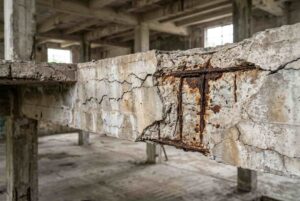
Aluminosis is not usually obvious until it is advanced. However, there are early signs that a trained eye can recognise:
- Longitudinal cracks in the ceiling, parallel to the joists.
- Rust stains on the ceiling, caused by the corroded steel reinforcement.
- Spalling of the concrete cover, leaving the steel exposed.
- Abnormal concrete colour. High-alumina concrete tends towards a yellowish-brown or chocolate tone, in contrast to the grey of Portland cement.
- Deformation or sagging of the floor slab (“bellies” in the ceiling).
- Persistent damp on the ceiling of the floor below.
- A dull sound when tapping the affected concrete.
None of these symptoms is exclusive to aluminosis: they can also appear for other reasons. That is why any suspicion must be confirmed with a rigorous technical analysis.
Technical diagnosis: how to confirm aluminosis
Confirming aluminosis requires analysis by qualified professionals:
Visual inspection and spot sampling
The first step. An architect examines the building and extracts small samples of concrete by drilling to visually examine their internal section. High-alumina concrete has characteristic tones (brown, reddish, ochre) that are very different from the grey of Portland cement.
Laboratory chemical analysis
This is the definitive test. Samples are sent to a laboratory to determine the presence of calcium aluminate using techniques such as spectroscopy or thermogravimetric analysis. It is the only scientifically conclusive way to confirm the defect.
Complementary non-destructive tests
Ultrasound, rebound hammer testing, X-rays and ground-penetrating radar complete the diagnosis without damaging the structure. They measure density, surface hardness and the internal condition of the reinforcement, and are combined to produce a complete map of the damage and its extent.
Once the diagnosis is complete, the technical team drafts a report assessing the condition of the building, the severity of the aluminosis, the affected areas and the recommended corrective measures.
Solutions and repair of aluminosis
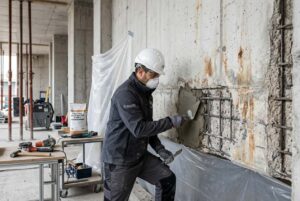
Repairing aluminosis depends on the degree of damage and economic feasibility. From least to most invasive:
1. Temporary propping
An emergency solution to stabilise the structure while the permanent repair is planned. Metal props are installed to relieve the load on the affected joists. It is temporary, not permanent.
2. Reinforcement with steel sections
Steel sections (IPN or UPN) are installed parallel to the affected joists and take on the load. A quick and effective intervention for moderate cases.
3. Reinforcement with carbon fibre or composites
A modern solution that provides structural reinforcement without adding weight or losing space. Very effective in cases of moderate reinforcement corrosion.
4. Partial replacement of joists
In advanced cases, the affected joists are removed and replaced with new elements. This is a considerable job that usually requires tenants to move out temporarily.
5. Full replacement or demolition
When aluminosis affects most of the building, the entire floor slab is rebuilt or, in extreme cases, the building is demolished and a new one built. It is the most expensive solution, but sometimes the only rational one.
The cost varies enormously: from €1,000-3,000 for spot repairs to €15,000-50,000 for refurbishing a whole home, or hundreds of thousands of euros for entire buildings. Aluminosis is usually addressed as part of broader building refurbishment projects, as it is rarely the only defect present in older buildings.
Legal, financial and insurance implications
Aluminosis is not just a technical problem: it has serious consequences on several fronts:
- Property depreciation of between 50% and 80% of market value. Banks are reluctant to grant mortgages on affected flats that have not been repaired.
- Obligation to repair. The owners’ association is responsible for keeping the structure in safe condition. Ignoring known aluminosis can lead to civil liability.
- Technical Building Inspection (ITE). Mandatory in most autonomous communities for buildings over 45-50 years old. If you have doubts about the consequences of failing it, read our article on what happens if a building has not passed the ITE.
- Buying property. If you are thinking of buying an older flat, always ask for a prior structural technical report.
- Refurbishment grants. The State Housing Plan and regional schemes subsidise up to 40-80% of the cost of structural refurbishment.
How to prevent problems if you live in an at-risk building
If your building was constructed between 1950 and 1980, these are the most useful measures for acting in advance:
- Request a preventive technical inspection even if it is not mandatory.
- Keep damp under control, as humidity and high temperatures accelerate the process.
- Watch for cracks and stains on ceilings and floor slabs. Early detection reduces repair costs.
- Plan the refurbishment as a whole. If you are going to work on the structure, take the opportunity to improve insulation and energy efficiency; the marginal costs are much lower.
As architects in Málaga and Marbella, at Mahatma Arquitectos we take a comprehensive approach to refurbishment: we resolve the structural defect while using the intervention to improve energy efficiency following BREEAM and Passivhaus guidelines.
🏢 Do you suspect your building has aluminosis?
We inspect the structure and propose the right solution. Find out about our building refurbishment in Málaga service and ask us for a no-obligation quote.
Frequently asked questions about aluminosis
No. High-alumina cement was only used in some of the buildings from that period, mainly in joists, and in specific geographical areas. In addition, favourable conditions (humidity, temperature) are needed for the defect to appear. A technical diagnosis is the only way to confirm it.
It depends on the degree. With spot repairs it is usually possible to keep living in the home with moderate disruption. For major structural replacements, occupants usually move out for 2-4 weeks. The technicians assess the risk and decide whether it is safe to stay during the works.
Usually not. Home insurance covers accidental damage, not hidden construction defects. Aluminosis is considered an original defect of the building. Some specific community policies do include partial cover; it is worth reviewing the policy in detail before taking on costs.
Yes, but for very different purposes. It is used in specific applications where rapid setting and resistance to high temperatures are needed (refractory linings, marine works, technical mortars). It has been banned for conventional structural uses in Spain since the 1980s.
