
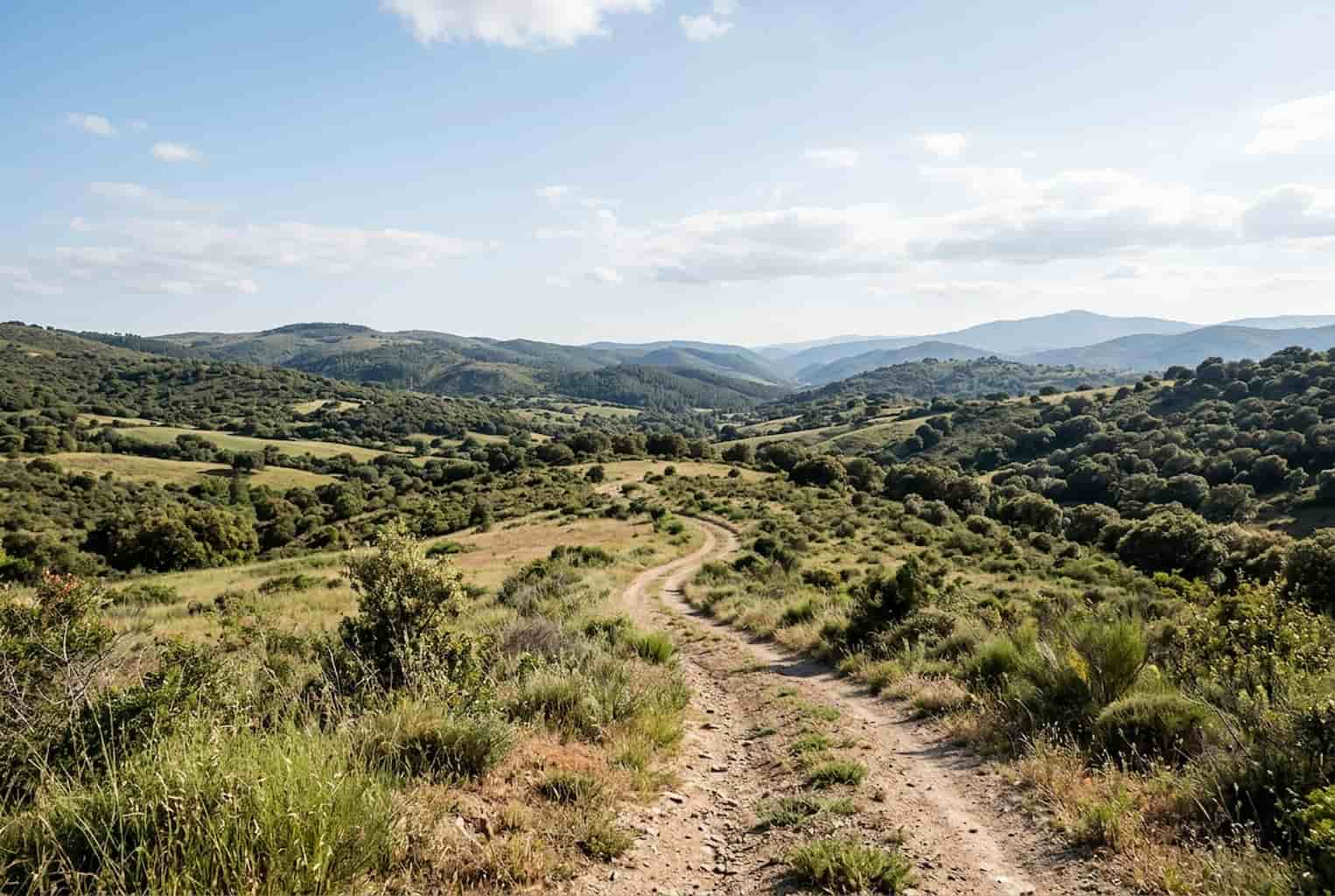
You cannot build freely on non-developable land, but that does not mean all construction is prohibited. In Andalusia, certain agricultural, livestock or forestry buildings, projects of public interest, refurbishments and, under very specific requirements, detached single-family homes can be authorised. What is actually possible depends on the land category, the municipal plan and the constraints affecting each plot.
Buying a rural plot assuming that, because it has enough square metres, you will be able to build a house on it is one of the most common mistakes we come across when analysing plots.
Size matters, but it is not the only factor. Two seemingly similar plots can have completely different possibilities because of their planning classification, environmental protection, proximity to other homes, flood risk or the municipality’s specific rules.
That is why, before buying or designing any building, it is essential to study the plot individually.
Non-developable land: what it means and what can be built
A non-developable plot is, broadly speaking, land that is not part of the urban fabric and cannot be developed as if it were a conventional urban plot.
In Andalusia, the current Law for the Promotion of Territorial Sustainability in Andalusia (LISTA) mainly uses the term rural land. However, the term “non-developable land” is still commonly found in older planning documents and in the paperwork of many properties.
Rural land is not unusable land. Its main function relates to agricultural, livestock, forestry and natural uses and other activities typical of the countryside.
In addition, the regulations allow certain building work, provided it is compatible with the planning rules and obtains the necessary authorisations.
🏡 Do you have a plot and want to know whether you can really build on it?
We analyse the planning rules, the constraints on the land and the architectural feasibility before you make any decisions or investments.
Check the feasibility of your project →
What can be done on non-developable land
The possibilities depend on the specific plot, but there are a number of activities that fit more easily within the rural land regime.
Buildings linked to a farming or livestock operation
Agricultural, livestock and forestry uses, and those related to the use of natural resources, are the most typical uses of rural land.
When justified by a genuine activity, buildings such as the following may be considered:
- Agricultural storehouses.
- Sheds or spaces for tools.
- Livestock facilities.
- Greenhouses.
- Buildings for storage or processing linked to the farm.
- Facilities needed for forestry activities.
This does not mean you can build any shed simply by stating that it will be used for farming. The size and features of the building must match the activity actually carried out.
Residential buildings linked to certain uses
Homes needed to carry out agricultural, forestry, livestock or other permitted activities may also be allowed when the need for them is properly justified.
The link must be genuine. It is not enough to plant a few trees or register a small farming activity just to justify a house.
Extraordinary projects
Andalusian legislation allows certain extraordinary projects which, by their nature, have to be located on rural land or serve a public or social purpose.
Depending on the project, this may include certain tourism activities, facilities, renewable energy installations or business projects whose location in the countryside is justified.
These projects require a specific analysis and prior authorisation before applying for the relevant permit.
Refurbishing existing buildings
A property may contain farmhouses, homes, storehouses or other old buildings. The fact that a building already exists does not automatically mean it can be refurbished or extended.
First you need to know its planning status: whether it has a permit, whether it complies with the planning rules, whether it is non-conforming or whether a specific regime applies to it.
That is why buying a property with an apparently old building without studying its legal status can cause serious problems later on.
Can you build a house on non-developable land?
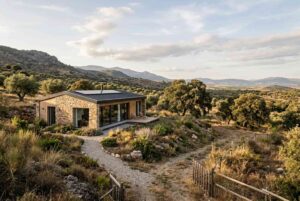
In Andalusia, certain detached single-family homes can indeed be authorised on rural land, even when they are not linked to a farm, but this does not give an automatic right to build a house on any plot.
The general regulations set a number of conditions for these detached homes:
- There can only be one detached single-family home per plot.
- As a general rule, the plot must have a minimum of 2.5 hectares.
- On forest land, the general minimum area is 5 hectares.
- The plot must be able to contain a circle with a 50-metre radius.
- The home must be more than 100 metres from other residential buildings.
- As a general rule, the footprint of the home cannot exceed 1% of the plot.
- Nor, as a general rule, can the maximum floor area exceed 1% of the plot.
- A minimum distance of 25 metres from the boundaries must be maintained.
- The general maximum height is two storeys.
- Basic services must be provided independently, preferably using sustainable solutions.
These parameters are a reference from the regional regulations, not a guarantee that you can build. Regional or municipal planning may introduce more restrictive conditions and even exclude certain areas from this possibility.
Comparison table: what can usually be built on rural land
| Project | Can it be feasible? | Main condition |
|---|---|---|
| Agricultural storehouse or facility | Yes | Must be justified by the farm |
| Livestock or forestry facility | Yes | Compatible with planning and sector regulations |
| Home linked to a farm | Can be authorised | Its need must be justified |
| Detached single-family home not linked to a farm | Can be authorised | Must meet the requirements of the LISTA, its Regulations and local planning |
| Refurbishment of an existing home | It depends | The building’s legal status must be checked |
| Prefabricated house to live in | Not automatically | Subject to planning control and permitted use |
| Rural hotel or tourism activity | May be feasible | May require authorisation as an extraordinary project |
| Conventional residential development | No | Rural land cannot be freely developed |
Can you live on non-developable land?
Yes, you can live in a home on rural land when its residential use is legal and has been properly authorised.
What you cannot do is buy a rural plot, put up any kind of structure and use it as a permanent home without first checking whether that use is permitted.
The right question, therefore, is not just “can you live on non-developable land?”, but “can a home be authorised on this particular plot?”.
The answer will depend on, among other factors:
- The exact land category.
- The size and shape of the plot.
- Any environmental or territorial protection.
- The municipal plan.
- Proximity to other homes.
- Flood risk.
- Access.
- The planned solution for water, sanitation and energy.
What about a prefabricated house or a caravan?
A prefabricated house is not a shortcut around planning regulations.
The fact that a home is built in a workshop, can be dismantled or has no conventional foundations does not mean it can be freely placed on a plot and used as a residence.
Installing prefabricated structures that could be used as homes is subject to administrative control. In addition, some municipal plans may expressly prohibit static caravans, modules or portable homes on rural land.
Before buying a modular home with the idea of putting it on a plot, it is best to check first whether residential use is feasible under planning rules.
What you cannot do freely on non-developable land
Owning the land does not mean you can transform it at will. Activities that should not be carried out without first checking their legality include:
- Building a home without authorisation.
- Dividing a property to create several residential plots.
- Putting up several houses to form a small residential cluster.
- Opening tracks or carrying out major earthworks without authorisation.
- Installing utilities that effectively create a housing development.
- Converting a farm shed into a home without applying for the corresponding change of use.
- Extending an existing building just because it appears in the Land Registry (Catastro).
One of the fundamental aims of the regulations is to prevent new settlements from forming in the countryside.
How to find out what you can build before buying land
If you are considering a property in Málaga, Marbella or any municipality on the Costa del Sol, our advice is not to base your decision solely on the information in the property listing.
1. Check the planning classification
The first step is to identify the plot’s actual status under the current planning rules.
The Land Registry (Catastro) provides physical and tax information, but whether you can build is determined by planning regulations.
If you want to look into this check in more detail, see our article How can you tell whether land is developable?.
2. Check for protections or constraints
A plot may be affected by watercourses, flood zones, roads, livestock trails, heritage, forest areas or environmental protections.
These circumstances can considerably reduce the area available for building or rule out certain uses altogether.
3. Study the plot, not just its square metres
A 30,000 m² plot is not necessarily buildable just because it exceeds a certain area.
Its shape, slopes, distances to boundaries, access, vegetation and location in relation to other buildings can be just as important as its overall size.
4. Ask for a technical analysis before buying
A preliminary study can show whether your idea for the property complies with the regulations before you sign a purchase agreement or pay a deposit.
Our work as architects in Málaga and architects in Marbella allows us to study the project from the perspective of regulations, architecture and the actual features of the land.
What permits are needed to build a home
When a detached home can legally be considered on rural land, you do not go straight to the building project.
As a general rule, a detached single-family home not linked to a farm requires prior authorisation from the Town Council before obtaining the planning permit.
During the process, the project, how it fits into the area and compliance with the applicable parameters are analysed. Other authorities may also be involved where there are sector-specific constraints.
Once planning feasibility has been confirmed and the necessary authorisations obtained, the architectural project can be developed and the corresponding building permit applied for.
For this reason, planning analysis must always come before home construction.
Sustainable architecture on rural land
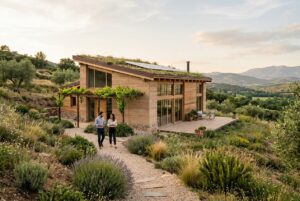
When the project is feasible, the characteristics of this type of plot offer a particularly interesting opportunity to design homes adapted to the climate and the landscape.
Orienting the home correctly, controlling solar radiation, using natural ventilation, improving insulation and reducing energy demand lowers consumption throughout the building’s lifetime.
At Pablo García Moreno – Mahatma Arquitectos we take an ecological and sustainable approach to architecture, drawing on design principles related to standards such as BREEAM and Passivhaus.
We also co-design projects with our clients so that they can take part in the decisions that shape the layout, the relationship between the home and the land, the materials and its energy performance.
So, is it worth buying non-developable land to build on?
It can be worth it, but only when the purchase is made after studying the feasibility of the project.
Rural land can allow a spectacular home that blends into the landscape, but it can also be completely incompatible with the residential use the buyer has in mind.
The difference between the two lies not in what the sales listing says or in whether neighbouring plots have houses. It lies in the regulations that specifically affect the plot and in the authorisations the project can obtain.
That is why, if your ultimate aim is to build, it is much safer to analyse the land first and buy afterwards than to acquire a plot and then try to fit the project around restrictions you were not aware of.
Frequently asked questions about non-developable land
Can you build a swimming pool on non-developable land?
There is no automatic authorisation just because a pool is an outdoor installation. Its feasibility will depend on the main permitted use, the home it is linked to, the municipal plan and the applicable footprint limits. Before designing it, the specific regulations for the plot must be checked.
Does a house appearing in the Land Registry mean it is legal?
Not necessarily. Land Registry information is mainly for physical and tax purposes and does not in itself prove that a building complies with planning law. You need to check the permits, the planning rules and its status with the relevant Town Council.
Can a rural property be divided to sell several plots?
Subdivisions of rural land are subject to planning and agricultural conditions and cannot be used to effectively create a residential subdivision. Before dividing a property, you must check the applicable minimum unit and obtain the relevant authorisations.
Does a home being recorded in the Property Registry guarantee that I can extend it?
No. Registration and the possibility of carrying out new building work are different matters. A home may be registered and yet have planning restrictions on extending its floor area, changing its use or carrying out certain works. Any extension must be checked against the current planning rules.
